Following three successful collaborations with the Asclepios project, the MEEVA (Medical Equipment for ExtraVehicular Activities) project has reached a major milestone. This year, the initiative has transitioned from an external collaboration into a formalized, official experiment integrated into the upcoming analogue space missions. This new status represents a big step forward for the team, strengthening the collaboration and enabling deeper technological integration with the mission framework.
Becoming an official experiment in the Asclepios initiative, significantly improves how MEEVA technology is incorporated into a realistic mission architecture. The team now has direct access to the Swiss analogue spacesuit developers and experts, gaining knowledge on the details of the space suit specifications, allowing the hardware to be tailored precisely to astronaut equipment. This collaboration enables a fast learning curve for optimizing backpack dimensions to ensure a superior fit, comfort, and ergonomic compatibility with the spacesuit systems.

Operational synchronicity is also enhanced, as MEEVA is now aligned with the official EVA (ExtraVehicular Activity) timelines, ensuring that sensor measurements are active during the most critical and relevant mission phases of astronaut activity. Furthermore, integration with the mission is supported through dedicated contact personnel and the SOPs (Standardization of Operating Procedures) according to Asclepios standards, guaranteeing complete synergy between the experiment team, mission control, and AA (Analogue Astronauts).
During an Asclepios mission, AA simulate the operations of a real exploration crew. They perform EVAs, maintain and repair a simulated scenario of a specific extraterrestrial celestial body base, like the moon, and conduct scientific experiments under the supervision of the MCC (Mission Control Center), replicating the operational challenges of planetary exploration. EVAs in particular represent the most hazardous phase of the mission, exposing astronauts to extreme temperatures, high physical stress, and intense psychological pressure. In such conditions, standard radio links alone are insufficient to ensure proper health monitoring.
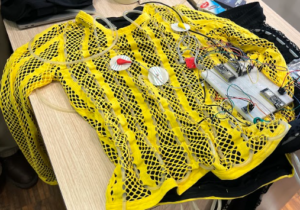
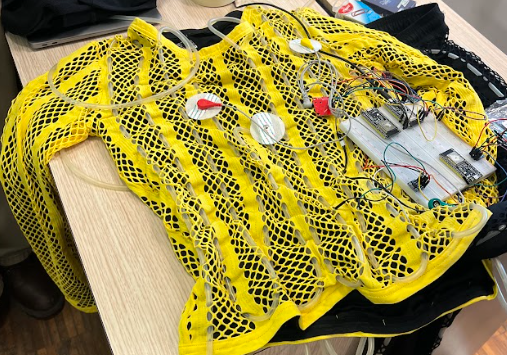
The MEEVA undervest addresses these risks through the integration of biomedical monitoring, thermal regulation, and embedded electronics into a wearable system. Physiological parameters such as heart rate, skin temperature, core temperature, respiratory cycles, blood oxygen saturation and skin conductivity are continuously measured to provide an estimation of the astronaut status. At the same time, a liquid based thermal control system makes coolant to circulate through integrated channels, transferring excess body heat to a phase change material heat sink that stabilizes the astronaut’s internal temperature. Additionally, the electronic subsystem manages data acquisition and filtering while transmitting it wirelessly through BLE (Bluetooth Low Energy), minimizing cables and improving overall comfort during EVA operations.
The real-time biometric data collected during the mission is later compared with psychological questionnaires completed after each EVA. This combination of physiological and subjective information allows researchers to better understand how astronauts react to demanding mission conditions and contributes to the development of predictive models for human performance during planetary exploration.
The first operational test of the project took place during the Asclepios IV mission in July 2024. This scenario provided valuable insight into the performance of the system under demanding operational conditions, providing positive initial results from the mission, confirmed by the astronauts feedback that the low-profile design of the vest allowed full mobility within the suit, while the active cooling system successfully mitigated the insulating effect of the suit during intense activity.
Building on these results, the project is now transitioning from a functional prototype toward a fully ready mission system, aiming to enhance the accuracy and robustness of the system for future missions. As the Asclepios team prepares its sixth analogue mission scheduled for July 2026, MEEVA continues to evolve from an experimental platform into a potential life-support monitoring technology. The project’s focus now lies in transforming experimental validation into a reliable system capable of improving astronaut safety, performance, and comfort during future exploration missions beyond Earth.