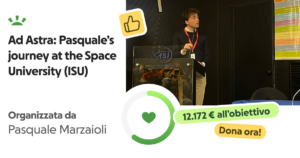
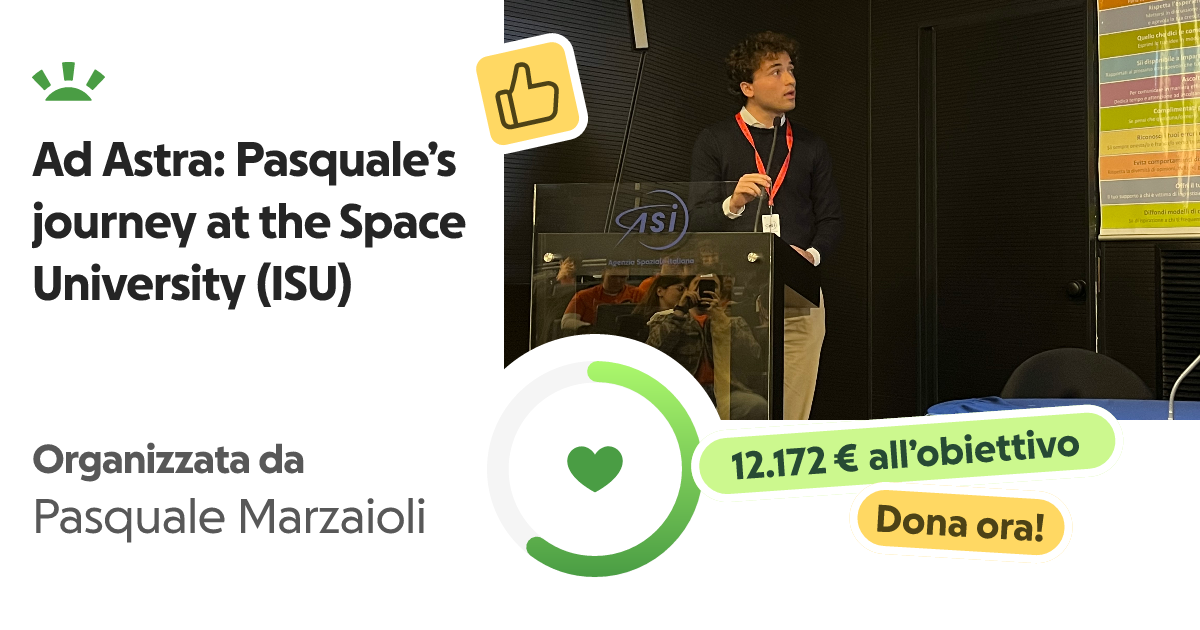
In the world of space engineering, innovation and technology, talent and dedication are essential, but sometimes they are not enough to get to the goal. Opportunities of bigger impact often come with significant financial barriers, which turn down the dreams of many young professionals. Today, there is the chance to help remove one of those barriers for a promising young engineer: Pasquale Marzaioli, a former member and current leader within the PoliSpace community.
Pasquale’s story begins in Maddaloni, a small town in southern Italy, where his passion for science took root at an early age. Driven by an insatiable curiosity for physics, mathematics, and the mysteries of space, he pursued aerospace engineering at the Politecnico di Milano, one of Europe’s leading universities in engineering. Over the past five years, he has not only built a strong academic foundation but also distinguished himself through hands-on experience and leadership in student space projects.
Within PoliSpace, Pasquale evolved from a systems engineering member into a Team Leader, contributing to the development of real space missions from the ground up. His commitment extends beyond Milan. Through the IGNIS project at the University of Naples Federico II, he worked as Head of Operations and systems engineer on a mission aimed at monitoring the Campi Flegrei volcanic area in his homeland. This initiative reflects not only technical competence but also a deep sense of responsibility toward society: using space technology to protect and give back to local communities.
Today, Pasquale stands at a really life changing moment in his journey. He has been accepted into the prestigious International Space University (ISU), where he will pursue the Space Science and Exploration track. ISU is globally recognized for shaping future leaders in the space sector, with strong collaborations with organizations such as NASA, European Space Agency, and Airbus. Becoming an extraordinary and well deserved achievement already for him but at a high cost.
The total tuition fee for the program is €27,000. Thanks to his merit, Pasquale has already been awarded a €14,000 scholarship from the European Space Agency, reducing the remaining amount to €13,000. Even so, this figure does not include accommodation or living expenses, making it a significant financial challenge for him and his family.
This is where the help of the community can make a difference. Supporting Pasquale means investing in a future engineer who has already demonstrated excellence, leadership, and a commitment to using space technology for societal benefit. It means enabling someone who has worked tirelessly to reach this opportunity, but needs collective support to take the final step. Every contribution, no matter the size, helps bring him closer to this once in a lifetime experience. And even if contributing financially is not possible, sharing his story can have a powerful impact.
Pasquale has committed to transparency throughout this journey, promising to share updates, experiences, and insights from ISU with everyone who supports him. In doing so, this becomes more than an individual achievement but a shared journey. Recalling that in space exploration, no mission is accomplished alone. It takes teams, collaboration, and a shared belief in pushing boundaries.
This is one of those moments. Let’s help Pasquale reach Ad Astra, toward the stars. 
[Support Pasquale’s Journey on GoFundMe] :
https://www.gofundme.com/f/ad-astra-pasquales-journey-at-the-space-university-isu